In today’s highly competitive digital marketplace, businesses often use the terms brand awareness and brand growth interchangeably. However, while they are closely connected, they represent two different stages of building a successful brand.
Brand awareness is about getting people to know and remember your brand. Brand growth is about turning that recognition into measurable business results.
Understanding the difference between the two can help businesses create smarter marketing strategies, allocate budgets effectively, and build long-term customer relationships.
What Is Brand Awareness?
Brand awareness refers to how familiar consumers are with your brand, products, or services.
Simply put, it answers the question:
“Do people know who we are?”
When customers can recognize your logo, remember your brand name, associate your brand with a particular product, or recall your advertising, your brand has achieved awareness.
Examples of Brand Awareness
Brand awareness can be built through:
- Social media campaigns
- Digital advertising
- Influencer marketing
- Content marketing
- SEO
- Video marketing
- PR and media coverage
- Events and sponsorships
- Consistent branding and visual identity
For example, if a consumer sees a particular logo and immediately knows which company it belongs to, that company has strong brand awareness.
What Is Brand Growth?
Brand growth goes beyond recognition. It focuses on increasing the overall value, reach, customer base, and revenue generated by a brand.
It answers a more advanced question:
“Is our brand becoming more valuable and successful?”
Brand growth can include:
- Increasing sales and revenue
- Acquiring new customers
- Improving customer retention
- Expanding into new markets
- Increasing market share
- Building customer loyalty
- Increasing brand preference
- Improving customer lifetime value
- Developing new products or services
A brand may be well-known but still struggle to grow. Therefore, awareness alone does not guarantee business success.
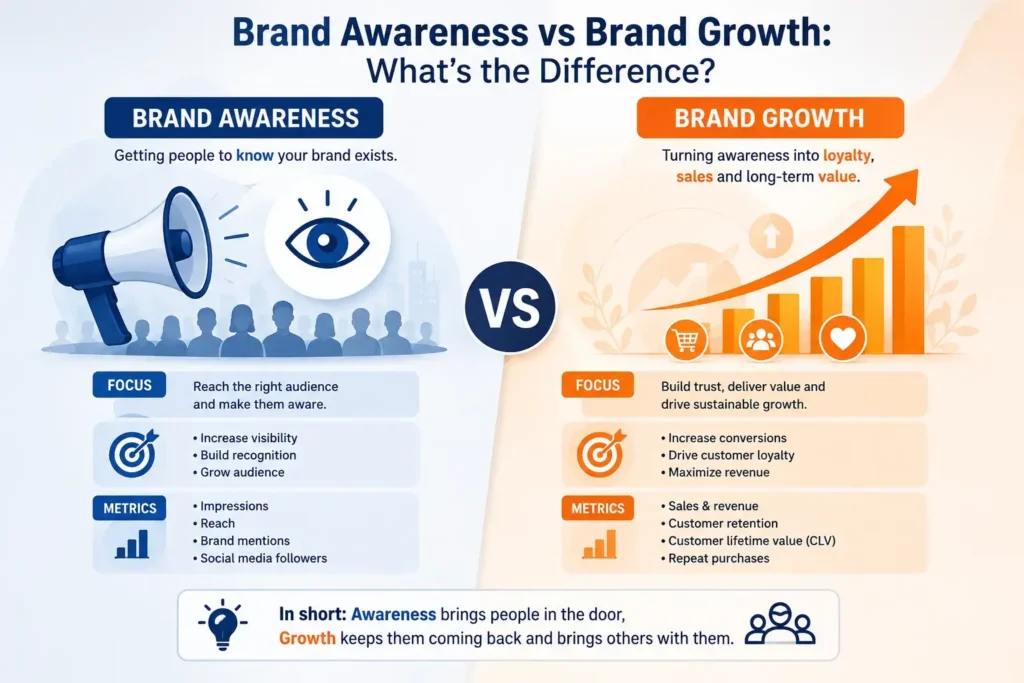
Brand Awareness vs Brand Growth: Key Difference
| Brand Awareness | Brand Growth |
|---|---|
| Focuses on recognition | Focuses on business results |
| Builds familiarity | Builds customer relationships |
| Measures how many people know your brand | Measures how the business is growing |
| Often focuses on reach and visibility | Focuses on revenue, customers and market share |
| Short- to medium-term marketing objective | Long-term business objective |
| Creates interest | Converts interest into action and loyalty |
The simplest way to understand the difference is:
Brand Awareness → “People know us.”
Brand Growth → “People choose us, buy from us, and stay with us.”
Why Brand Awareness Matters
Before customers can consider buying from you, they need to know that your brand exists.
Strong brand awareness can help businesses:
1. Increase Recognition
Consistent branding makes it easier for customers to recognize your business across different platforms.
2. Build Trust
Repeated exposure to useful and relevant content can make a brand more familiar and credible.
3. Improve Customer Consideration
When customers are already familiar with your brand, they are more likely to consider it when making a purchase decision.
4. Reduce Customer Acquisition Challenges
A recognizable brand can make marketing campaigns more effective because customers already have some familiarity with the business.
Why Brand Growth Matters
Awareness is only the beginning. A successful brand needs to convert visibility into sustainable growth.
1. More Customers
Growth strategies focus on attracting new customers while retaining existing ones.
2. Higher Revenue
Effective brand growth connects marketing activities with measurable business outcomes.
3. Stronger Customer Loyalty
Brands that consistently deliver value can develop long-term relationships with customers.
4. Greater Market Share
A growing brand can expand its presence and compete more effectively within its industry.
5. Long-Term Business Value
A strong brand becomes an asset that can generate value beyond individual marketing campaigns.
How Brand Awareness Leads to Brand Growth
Brand awareness and brand growth should not be treated as competing strategies. Instead, they work together as part of the customer journey.
A typical journey looks like this:
Awareness → Interest → Consideration → Conversion → Loyalty → Advocacy → Growth
For example, imagine a customer discovers a brand through an Instagram video.
First, they become aware of the brand.
Later, they visit the website and explore its products.
They compare the brand with competitors.
Eventually, they make a purchase.
If they have a positive experience, they may purchase again and recommend the brand to others.
This is how awareness can become growth.
Which One Should Your Business Focus On?
The answer depends on your current business stage and objectives.
If You Are a New Brand
Your primary focus may need to be brand awareness.
You need to establish your identity, reach your target audience, and communicate what makes your business different.
If You Are an Established Brand
Your focus should increasingly shift toward brand growth.
This means converting awareness into:
- Leads
- Customers
- Repeat purchases
- Revenue
- Market share
- Customer loyalty
If Your Brand Is Well-Known but Not Growing
This is an important warning sign.
If people know your brand but sales and customer numbers are not increasing, the problem may not be awareness.
You may need to examine:
- Product-market fit
- Customer experience
- Pricing
- Conversion rates
- Marketing messaging
- Customer retention
- Competitive positioning
How Digital Marketing Supports Both
Modern digital marketing can help businesses build awareness and drive growth simultaneously.
SEO
SEO increases your brand’s visibility when customers search for relevant products, services, and information.
Social Media Marketing
Social platforms help brands build communities, engage audiences, and increase recognition.
Performance Marketing
Paid advertising can help businesses reach highly targeted audiences and generate measurable leads and sales.
Content Marketing
Educational and valuable content builds credibility while helping brands stay connected with their audiences.
Email Marketing
Email campaigns can turn interested prospects into customers and encourage existing customers to return.
AI-Powered Marketing
AI can help businesses analyze customer behavior, personalize communication, automate marketing workflows, and identify growth opportunities.
How to Measure Brand Awareness
Some important brand awareness metrics include:
- Brand search volume
- Social media reach
- Impressions
- Website traffic
- Social media mentions
- Video views
- Audience growth
- Share of voice
- Direct website traffic
These metrics help you understand whether more people are discovering and remembering your brand.
How to Measure Brand Growth
Brand growth requires more business-focused metrics, such as:
- Revenue growth
- Customer acquisition
- Customer retention
- Conversion rate
- Customer lifetime value
- Market share
- Repeat purchase rate
- Lead generation
- Return on marketing investment
- Profitability
The key is to connect marketing activity with actual business outcomes.